Dubai is the leading real estate market in the Persian Gulf: personal income tax is 0%¹, and owning property from $544,588² grants eligibility for a long-term Golden Visa.
Real estate in Dubai: what makes the region interesting
Dubai is the leading real estate market in the Persian Gulf: personal income tax is 0%¹, and owning property from $544,588² grants eligibility for a long-term Golden Visa.
Dubai has bet not on oil but on trade, logistics, tourism and real estate, and the country's economy shows it. UAE GDP growth in 2024 was +4%⁵, and the average over 2016–2024 was +2.1%⁶ per year. Inflation stands at 1.3%⁴ (2025), and GNI per capita is $51,550⁷ a year. Over 2016–2025 the population changed by +28.9%⁸ and reached 11.5M⁹. Housing demand here comes from people who move to live and work.
Country economy in numbers
Inflation
1.3%
by country · World Bank · 2016 – 2025
Income per person per year
$51,550
by country · World Bank · 2016 – 2024
Economic growth
+4%
by country · World Bank · 2016 – 2024
Unemployment
2.2%
by country · World Bank · 2016 – 2025
Transactions go through the Dubai Land Department. Registration costs 4%³ of the price, and if you buy with a mortgage, add 0.25%¹⁰ of the loan amount. The tax side is simple: an individual's income from renting out or selling real estate without a business licence is not subject to Corporate Tax, regardless of the number of properties or the amount of income¹¹. Ownership rights: foreigners may own real estate in Dubai on a freehold basis without time limits in areas designated by the Ruler, where leasehold and usufruct rights of up to 99 years are also available¹².
Where to live and buy
Attractive areas of Dubai
Dubai Marina
Waterfront apartments
Skyscrapers along the canal and a waterfront promenade make this one of the city's most in-demand rental districts.
Business Bay
Business hub
Offices, apartments and views of Burj Khalifa; popular with short-term tenants.
Downtown Dubai
The city's showcase
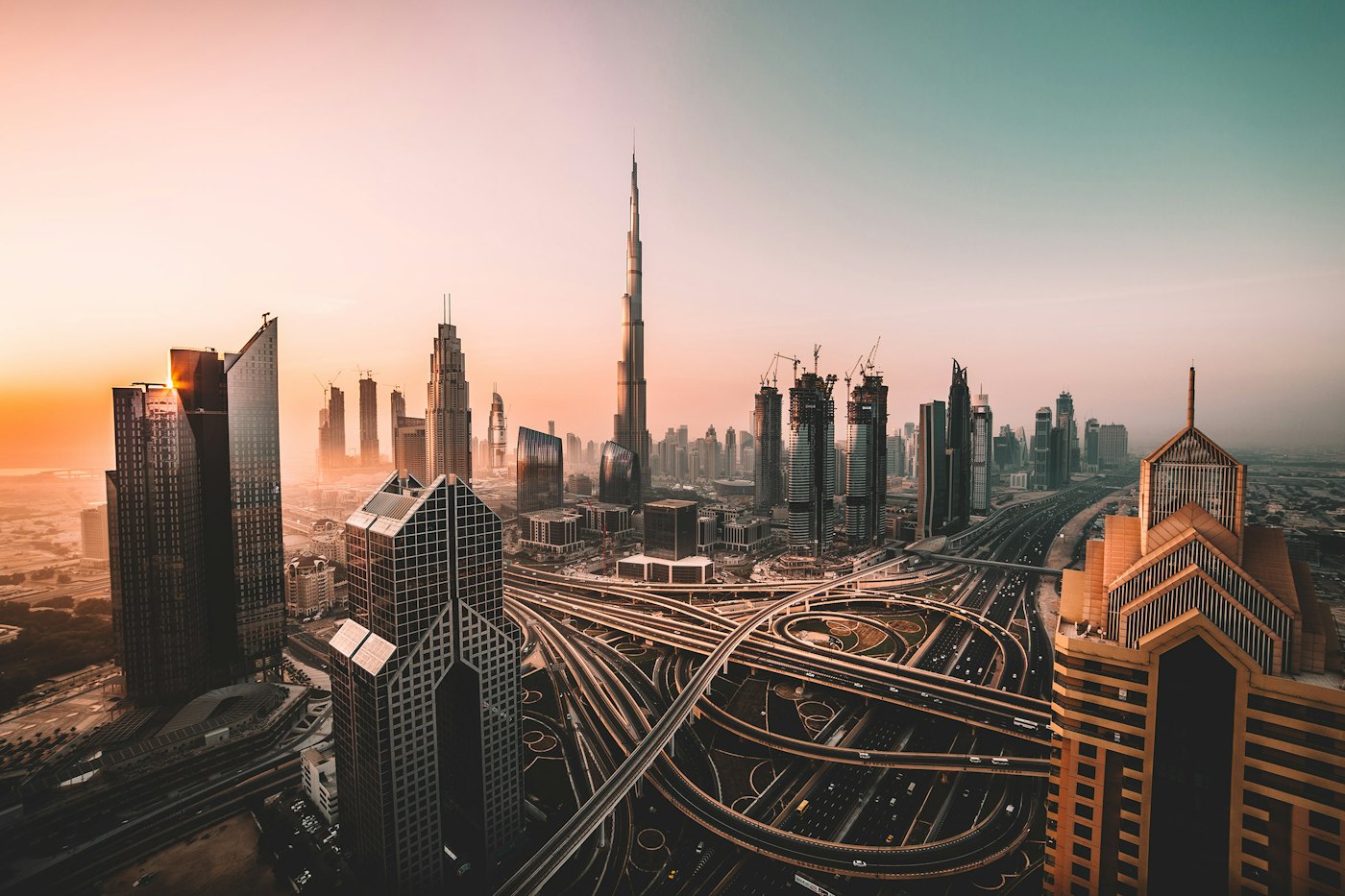
Burj Khalifa, Dubai Mall, fountains: a prestigious address in the heart of the city.
Palm Jumeirah
Legendary island
Villas and residences on a man-made island, with private beaches.
Arabian Ranches
Family-friendly
Townhouses and villas with gardens, good schools and peace and quiet: the choice of families with children.
Dubai Hills
Green premium
Parkland, golf and townhouses; a balance between city and suburbs.
Jumeirah Village Circle
Affordable entry
JVC: dense new-build development, popular with tenants.
What to see
Attractions in Dubai
Skyscraper
Burj Khalifa
The world's tallest building, 828 m; observation decks and address No. 1.
Shopping
Dubai Mall
One of the planet's largest malls, with an aquarium and an ice rink under one roof.
Engineering marvel
Palm Jumeirah
A man-made palm-shaped island with hotels and residences.
Fountains
Dubai Fountain
A light-and-music fountain at the foot of the Burj Khalifa.
History
Old Dubai · Al Fahidi
Neighborhoods along Dubai Creek, a gold and spice souk, and the emirate's museum.
Entertainment
Ski Dubai
An indoor ski slope with real snow in the middle of the desert.
Natural anchors
Nature and climate of Dubai
≈ 5 m above sea level — low: coastal zone at risk of sea level rise.
Coastline
Persian Gulf, ~70 km
Water
21 °C¹³ in January · 34 °C¹³ in July
Precipitation
37 mm¹⁴ per year
Green spaces
Dubai Hills, Zabeel and Safa parks
Swimming
year-round, water 21 °C¹³…34 °C¹³
Diving
reefs and wrecks off Fujairah (east coast)
Surfing
weak swell, season is winter (Kite Beach)
Hotels
575¹⁵ accommodation properties within 50 km
Average temperatures and precipitation by month
Loading climate data…
Climate. Hot and dry: summer (June–September) is the toughest time of year, while winter is mild and sunny. Comfortable season — October – April.
Beaches are open year-round, but they're really comfortable from November to March. In summer, humidity off the Gulf makes the heat exhausting even in the shade. All the greenery in the city is man-made: parks and lawns depend on desalinated water and drip irrigation, and without it this would be desert. It hardly rains at all, so life outdoors revolves around the cool season. Just beyond the ring road, the real desert begins: safaris, dunes and camping, half an hour's drive from the skyscrapers.
Historical Background
How Dubai Became This Way
As recently as the mid-20th century, Dubai lived off pearl diving and maritime trade around Dubai Creek. Oil was found late and in small amounts, so the emirate bet not on raw materials but on trade, logistics, tourism and real estate. Free economic zones, the region's largest airport hub and the absence of personal income tax turned a trading port into a global city within a single generation. That fork in the road explains today's Dubai: its property market is not a byproduct of oil but one of the engines of the economy.
1833
Settlement founded on Dubai Creek
1966
Oil discovered, modernization begins
1985
Emirates airline and the Jebel Ali Free Zone established
2010
Burj Khalifa opens, symbol of the new Dubai
2020
Expo 2020, a new wave of construction and demand
Society, language, religion
How Life is Organized in Dubai
Language
Arabic (official); English, the language of daily life and business
Religion
Islam; other faiths are free to practice
Residents
most residents are expats who moved here for work
Political stability
80 out of 100¹⁶
Currency
dirham (AED), pegged to the US dollar
Lifestyle
tolerant toward foreigners who respect local norms
Dubai is a city of expats: most residents came here to work. That is why the environment is rare for the region: multicultural, English-speaking, and still calm. Islam sets the calendar and some rules (Ramadan, dress code in mosques), but daily life for residents remains secular and comfortable.
Population and stability
Country population
11.5M
by country · World Bank · 2016 – 2025
Political stability
80 out of 100
by country · World Bank · 2016 – 2025
Suitable for
For whom Dubai
Investor
Rental income tax is 0%¹¹, transfer registration is 4%³: clear math for renting and reselling.
Family
Townhouses in Arabian Ranches and Dubai Hills, international schools, and a calm urban environment.
Relocator
English as the everyday language, a Golden Visa with property from $544,588², and world-class infrastructure.
Retiree
Warm, sunny winters and well-developed private healthcare.
Risks and pitfalls
Investment risks in Dubai
Honest about what is rarely written in ads. Some natural risks — flooding, sea level rise, coastal erosion — are shown as separate layers on the analytics map by region.
FAQ
Real Estate FAQ in Dubai
Data Sources: Wikidata, Wikivoyage. Text prepared by the Plentovia editorial team.
2ICP — Golden Residency Guide — a 10-year Golden Visa residency is available to owners of UAE real estate worth at least AED 2,000,000 in total — financing from an approved local bank and off-plan purchases from an approved developer are allowed; verified October 19, 2026
4World Bank — Inflation, 2025 · World Bank, World Development Indicators / Worldwide Governance Indicators (CC BY 4.0)
5World Bank — Economic growth, 2024 · World Bank, World Development Indicators / Worldwide Governance Indicators (CC BY 4.0)
6World Bank — Economic growth, 2016–2024; calculated from source data · World Bank, World Development Indicators / Worldwide Governance Indicators (CC BY 4.0)
7World Bank — Income per person per year, 2024 · World Bank, World Development Indicators / Worldwide Governance Indicators (CC BY 4.0)
8World Bank — Country population, 2016–2025; calculated from source data · World Bank, World Development Indicators / Worldwide Governance Indicators (CC BY 4.0)
9World Bank — Country population, 2025 · World Bank, World Development Indicators / Worldwide Governance Indicators (CC BY 4.0)